About Me

My photo
I am an International Development student from Canada who is studying in India on a semester abroad. I will be traveling and studying through India for five months from January until May.

Saturday, April 14, 2012

Amritsar


I arrived in Amritsar at eight in the morning with three of my friends after taking a night train from Delhi. We didn't have any firm plans about where we would stay or how long we would spend in the city. The Golden Temple is the main attraction in Amritsar. It is a beautiful Sikh temple that is well worth the trip. Sikhism is a very inclusive religion and we were told that there is a hostel to stay in at the Golden Temple for pilgrims and foreigners.

We headed for the Golden Temple from the train station and hoped for the best. It was a little confusing at first getting to the temple. At one point we were wandering around the temple grounds without our shoes, all of our bags, and scarves over our heads. We had to take off our shoes and cover our heads on the temple grounds. We were stopped by a police officer and he was really nice. He made a point to warn us about pick pockets and show us the way to the temple. The hostel is on the grounds of the Golden Temple, literally a 2 minute walk away.

We showed up at the hostel and there was a man with a full beard and turban who warmly greeted us and ushered us into the rooms. The hostel is totally free and our area is specifically for foreigners. I met some of the coolest people at this hostel. There was one cute, 21 year old girl from France who was travelling on her own through north India for five months (until the money runs out). She came to India speaking only French and learned English in India during the time that she was here. I was amazed because we were having a full conversation and although she had a strong french accent, I did not have any trouble understanding her.

Between the hostel and the temple there is a dinning hall which is also free and included with the hostel . We followed the noise of the clanging dishes to the dinning hall, which was a crazy place. The dinning hall is completely run by volunteers and it runs off of donations. As you come in there are groups of people sitting on the floor cutting vegetables and prepping food. Then there are people on either side of the entrance that hand you sectioned plates, bowls, and spoons. You come into the main dinning hall and there are long mats set up along the floor where everyone sits and is served by people who come by with bread, rice pudding, dall, and other curries. After you eat you hand your dishes to people who are pass then down a line of people and wash them. It is a very amazing and efficient process.

I was amazed by how welcoming and inclusive the hostel and dinning hall were. There were places to leave donations but we were not directly asked at any time to leave one and people did not think twice about letting us sleep in the hostel or eat our meals in the dinning hall.

The Golden Temple itself was beautiful and it is so hard to describe. It is open 24 hours a day and since our hostel was a quick walk to the temple, we went several times in the day.


We only spent one day in Amritsar but it was a full, exciting day. After being in Jaipur for so long I forgot how much I love being on the road and being able to see new amazing things all the time. After getting settled in at the Golden Temple, we went to Jallianwala Bagh, which is a park that commemorates those Indians killed and wounded by the British authorities there in 1919. In the park there is a well into which hundreds of people jumped into to avoid bullets. There was some sort of demonstration taking place while we were there.


After that we went to Mata Hindu Temple. This temple was not an ancient temple but it was really fun. It felt like I was in a fun house because there would be rooms of mirrors from floor to ceiling and crazy slanted walkways. Also there were caves built into the temple that you had to crawl through and at the end of the temple there was a cave with water in it that you had to walk through.

Amritsar is close to the Pakistan border and every evening a closing ceremonies takes place which we were told was worth going to. We met up with four people from our hostel, two people from Israel and two from Denmark. We hired a guy to take us to the border for the ceremonies in his van and on the way we picked up an Indian family to squeeze in for the ride. There were bleachers set up on the Indian and Pakistan side of the border. The Indian side had a much better turnout but my friend later learned that this may be due to the fact that it is Ramadan.

Before the ceremony started, there was an opportunity for people to come down from the stands and dance to the music that they were playing. It seemed like so much fun so I went down and joined. I could recognize a few of the songs because they were from the Bollywood films that I watched in my host family. When Jai Ho came on I was singing along and the Indian women were impressed. I tried to pick up on some of their dance moves and they were more than happy to show me. Some women came up to me and held my hands and we spun each other around. This seemed to be a normal thing to do on the dance floor.


The closing ceremonies itself felt like a kind of pep rally almost between India and Pakistan. The fans would chant slogans about their nation in a call and response style. There was also a part where one man from each country would hold a note for as long as they could and it would be a competition to see who could do it for the longest.

The military put on a performance in which they were walking in a synchronized fashion and would do huge kicks with their legs. They were so serious and fierce- men and women.

In the evening at the hostel all of the rooms in the building as well as the entire courtyard were filled with Indian families. I could not believe that so many people had fit in this space.  

JAIPUR- Home Stay Experience


For the last month I have been living with an Indian family in Jaipur and studying at Kanodia Girls Collage. It has definitely been a highlight of the trip because I was able to get a different perspective on life within an Indian house and get a better understanding of the culture. My host parents were an older couple whose children had already grown up and live away from home. My host dad was a retired sociology professor from the University of Rajasthan. He was very formal with some aspects of my stay and told me that I could either call him Mr. Modi or Professor Modi, although I could call his wife and my host mom “Ma”. Mr. Modi was very interesting to talk to about almost any subject. He spoke English perfectly and was well travelled. The focus of his research was on leisure and during the time that we were staying in Jaipur, he had to leave for a few days at a time to speak at different international conferences.

Ma was a very cute lady who was always making sure that my host partner and I were well taken care of. Her English was not as strong as Mr. Modi's so we had a little bit of trouble communicating sometimes. When it came to making us eat more and more, Ma's English was great. Her best lines were “one more chapati?!”, “you need to eat more”, “you finish this”, and “anything more?”. She was very concerned with not letting any food go to waste so every meal she took it as her challenge to make sure that everything was finished. Eventually Ma started to understand that we were not going to eat more than two pieces of bread with our meals and she stopped making more. Since Ma and Mr. Modi's marriage, Ma was responsible for keeping the house in order and raising the children while Mr. Modi finished his education and then went off to work. I felt as though she treated my host partner and I as her children when we were staying with her.

Every morning before school, Ma would prepare us our usual breakfast of cornflakes, papiya, 2 pieces of toast, and chai tea. Many mornings she would also give us sweets and cookies and make sure that we tried each kind. Ma would also pack our lunches in the morning and see us off to school with a hug or a pat on the hip. In the evening, when we returned home from school at about 6:00, we would have tea with Ma. She always arranged a tray for us with fruit, cookies, and salty snacks. If she felt that we were not eating enough then she would tell us which ones were homemade and then we would eat at least those.


I really enjoyed this time with Ma because it was a calm time of the day for her when she wasn't preparing or serving food and could relax with us. We watched a lot of television at this time with Ma and it turned out to be a good way to get over the language barrier a bit. Ma loved her Indian soaps and almost every night we watched a show called “Hitler Didi” (meaning strong sister) from 8:00 to 8:30.

Ma wore a different sari everyday and so out of curiosity, one day after tea I asked to see her sari collection. 


Mr and Ms. Modi had a servant come to the house everyday day named Raju. He was about my age and spoke English a little bit better than Ma. He worked everyday from 9-9 in the house mostly cleaning, gardening, and helping Ma in the kitchen. It was really hard for me to get used to this kind of situation and in the beginning I would try and do everything for myself and thank him for everything. Ma would sometimes tell me to let Raju do it and one day he told me that it he didn't mind doing things for us because it was his job. Raju would also watch tv with us in the evenings. He was a big fan of Bollywood and Cricket and he would try his best to explain who were the top “heroes” and “heroins” (celebrities) of Bollywood and the rules of cricket.


It was really interesting to see the family dynamic and especially the relationship between men and women in the family. Ma would do all of the cooking for meals and she would often not eat her meal until we were finished. We would eat breakfast and dinner with Mr. Modi and Ma would be going back and forth from the kitchen to the table serving us. This was partly due to the fact that Indians like to have fresh bread with their meals so Ma would make the chapatis fresh one at a time so that when you finished your first then your second piece would be hot and fresh. After Ma was satisfied that we had everything that we needed then she would sit with us and eat her food.

For one week during our stay, Mr. Modi had to travel for a conference so their daughter in law came to help out in the house. Prinka was about 30 and her English was really good so it was easier to communicate with Ma through her. Prinka took on the same domestic responsibilities that Ma had during her stay. On the last day of her stay, Prinka's husband (Mr.Modi's son) came to stay at the house and we had breakfast with him. Ma brought out toast for him and when he father told him to put the butter on his toast while it is still hot he said that his wife always does it. As if that was her que, Prinka came from the kitchen and buttered his toast.

One of the best conversations that I had with my host father was on the last evening of my stay and we started to talk about marriage. Apparently about 90% of marriages in India today are arranged and parents feel as though it is their duty to find a spouse for their children. Out of the six children that he has, all but one are arranged. His oldest son was an ISS officer (very competitive, prestigious position) and he married out of love to a woman that he met at a collage function. He told me that there was some challenges to this marriage because they were marrying out of their community (I understood this as meaning a subgroup of their caste). He also said that it is very difficult and costly to marry four daughters. Dowries are illegal in India and Mr. Modi was insistent that they didn't agree with or partake in giving a dowry but there was still some kind of money transaction that took place.  


Indian Wedding


At breakfast one day, our host family invited my host partner, Rachael and I to the wedding that they would be attending the following evening. The wedding was for my host father, Professor Modi's good friend's son. Apparently wedding dates are chosen based on the astrology and this would be one of the last days for weddings for the next 30 days. It was really great timing and we could not be more excited to attend the wedding. We were told that it would be a very nice wedding, although not as over the top as some other weddings in which the family spends huge amounts of money.

Although a sari may appear to be one piece of fabric that is elaborately wrapped in order to make an outfit, it actually consists of three separate pieces. There is a long underskirt that holds up the sari, the blouse, which looks like a short belly top that is tailored to each person from the extra fabric of the sari and the sari itself, which is the long fabric that is folded and wrapped.

In the evening, Ma let Rachael and I each borrow a sari and we took turns having her wrap them for us. The whole process took about 10 to 15 minutes although she assured me that she is much faster at wrapping her own in the morning because she is in the routine.


Every sari is the same size and due to my height, Ma had a harder time wrapping my sari and had to use extra pins to keep my sari from falling down. Normally, women will fold the fabric of the sari so that it falls nicely then tuck the top of the folds into the underskirt but this would make it too short for me and Ma had to rethink her sari folding strategy for me. In the end, I had 5 safety pins holding my sari nicely in place and Ma only had one pin.


We arrived at the wedding and at the first area there were two elaborate chairs on the stage and a set of chairs facing the stage. On one of the chairs sat the groom and he was dressed in plenty of gold with a large hat on. When we were leaving at the end of the night, the bride had joined the groom on the stage in her chair. They both looked tired and a little uncomfortable with all of the attention that they were receiving. Indian weddings go on for many days with different rituals and ceremonies.

Rachael and I were the only white people at this wedding and we drew a lot of attention because of this. Many of the guests attending the wedding were very kind and welcoming. They really appreciated the fact that we were wearing saris. Many people came up to us and told our host parents that we looked great in the saris. I think that a few of the older men were interested in Rachael and I but our host father would tell them no. It seemed as though each time I looked up from my meal or conversation that there were many eyes on me.

The younger children were very curious about us but were very shy to be around us. There was one little boy who follow us around for most of the night and would just stare at us. I said hello to him at one point and he got a little embarrassed. My host mother told him in Hindi that he could shake our hands and he was very happy to do this.

The food at this wedding was really good and by the end of the night I was feeling a little uncomfortable having my stomach showing in my sari. My host parents understood that we could not eat everything at this wedding because it could make us sick when Indian people could eat it and be ok. They were very good about explaining what everything was and telling us which foods to avoid.

We started with a few appetizers which came on small paper plates. Following this we went for the main course, which was more than enough for me. At the main course there was rice and papadan (type of bread) to go with the meal and dessert to finish the meal. At this point I thought that the meal was over. There was another station with a tandoor oven and they were preparing fresh naan and roti. We had to try this bread because it was so fresh. Our host family was shocked when we said that we did not want gee (butter) on top of our bread.

We were standing and eating our meal, which actually worked out well for me. Since I was holding the plate in my left hand then I could only use my right hand to eat with. I was not tempted to tear my bread with both hands (In India, you serve with your left hand and eat with your right hand).

Our host father told us that we had to try some more Indian sweets, then have ice cream before we would leave the wedding. I tried a few of the desserts that I was not too crazy about and then they brought out a dessert that tasted just like funnel cake with a sticky icing. These desserts were in smaller shapes that almost looked similar to pretzels and they were so good while they were still warm. I was already quite full from everything that I had already eaten at the wedding but could not resist eating seconds of this dessert.

I could see be the way people treated Professor Modi (my host father) that he was very respected. Each person that greeted him would put their hands together, say “namaste”, and touch his feet.

Temple


My host family told me that the particular God for their household is Ganesh, which is the elephant god. One evening after dinner they asked me if I wanted to join them at the temple and I said that I would love to. It was a Wednesday, which is the worship day for Ganesh.

On the way to the temple, we went to a sweets shop which was apparently a very famous Indian sweets shop in Jaipur. I was unsure what we were going to do with the sweets until we got to the temple. Along the entrance to the temple many beggars were lined up and there were also temporary sweets stands set up.

I followed as my host family did and took off my shoes then washed my hands. On the stairs up to the temple, my host parents bowed their heads and touched the steps as they walked in. At each door to the temple there is a bell that each person must ring when they enter and some people will ring this many times. Mr. Modi said that maybe this was to tell Ganesh that you are here and to listen to your prayers. I noticed that this temple is much more informal than a catholic temple- it is open from 4am to 11pm and people will come at any time and do individual worship. At the front of the temple there is a shrine to Ganesh with many plates of sweets around it. There are two men standing in the area with the shrine and they are taking donations and offerings. 

When you make a donation, you get a sweet from the plates around the shrine. Ma gave me 10 rupees and I was given a small handful of sweets. When she made her second donation of 100 rupees, she was given a huge sweet the size of an orange. I did not know what to do with my sweet so I awkwardly held the buttery sweet in my hand until I realized that no one else was still holding their sweets. At this point I cautiously started eating my sweet and Ma said “Good! Eat”, which is a typical comment from her. Mr. Modi later told me that sweets are auspicious.

The temple was busy with people pushing through to make their offering and pray to Ganesh. Ma and I stoped at one point in the temple where there was a prayer written on the wall in Hindi and people were reading this prayer to themselves and individually praying.

When we exited the temple, Mr. Modi broke up some of the sweets that he had purchased into small pieces and handed them to strangers outside of the temple. This seemed to be a common thing to do because most of them accepted and those that did not respectfully put their hands together, just like when people say “namaste”.  

My joint birthday with Lord Rama


For nine days up until April 1st, my host mom had been fasting as a religious duty. During her fast she could only eat one meal at the middle of the day and warm milk in the evening. Until I came to India I did not know that I shared my birthday (April 1) with the Hindu Lord Rama.

Lord Rama's birthday is also a celebration of children. Before those who were fasting could end their fast they must feed the children. It is almost like an Indian version of Halloween. The children spend the day going around to the houses in the neighbourhood eating and at the end of their stay at each house they are given a small gift. At my house the children got a small Tupperware container, 10 rupees, and two sweets.

I decided to stay around the house for the morning to see the celebration. In India it is seen as a sign of respect to touch the feed of elders when greeting them, however on this day, Ma greeted all of the children this was when they came into the house. In the living room, Raju set mats on the floor for the children to sit on and they were served Punjabi style. As they were eating, Ma tied the sacred thread around their wrist and put red paint and rice on their forehead.

In the evening we had a big feast to celebrate my birthday as well as Lord Rama's.


Monday, March 26, 2012

Taj Mahal (Agra)


Finally after travelling and living in India for three months I can say that I have seen the Taj Mahal! I do not usually get very excited about buildings but the Taj Mahal is obviously something that you have to see when coming to India.

The Taj Mahal was built by Shah Jahan as a memorial for his second wife who died giving birth to their 14th child. Not long after the Taj Mahal was completed, Shah Jahan was overthrown by his son Aurandzeb and imprisoned in Agra Fort where for the rest of his days he could only gaze out at his creation through a window. Following his death, Shah Jahan was buried at the Taj Mahal alongside his second wife.

We arrived in Agra (the city of the Taj Mahal) in the evening and were really excited to see the Taj Mahal right away even though we were going in the morning. In the area surrounding the Taj Mahal, called the Taj Gang there are numerous restaurants claiming to have the best rooftop view of the Taj Mahal and we chose one that had been recommended in a guidebook. By the time that we got to the restaurant it was about 8:00 pm so it was dark out and we did not have the best view of the city skyline. We thought that we could make out the silhouette of the Taj Mahal from the rooftop and were a little disappointed although none of us would admit it until the next day. When we went back to that same restaurant for breakfast the next morning we realized that we mistook another building for the Taj Mahal. In the daylight, this restaurant did have the best view of the Taj Mahal.

The Taj Mahal is very touristy although I embarrassed it and enjoyed myself. The ticket for admission is the highest that I have paid anywhere so far. The foreigner price was 750 rupees and the Indian price was about 150 rupees and this allows you a one day, one time entry. I was a little disappointed that I could not come back and see the Taj at different times in the day so I made sure to take lots of pictures.


In order to avoid the crowds and heat, we got to the Taj Mahal at 6:30am. This time was perfect because it was quiet and peaceful and the lighting on the building was great. The garden walkway leading up to the Taj Mahal has of Indian and foreign tourists trying to get the best picture of themselves in front of the Taj. This is very funny to watch although I can not deny that I did the same.

My friend Kat had a really good line that she used when people asked her to take their photo. She would say, “so... do you want the building in the back or not?”.


I was surprised by how big the Taj Mahal actually is. I think that no picture can do justice to the Taj Mahal. The inside was not as impressive as the outside although it was very beautiful and elaborate- all marble. Apparently the Taj Mahal underwent a huge restoration project in the early 20th century and it looks as immaculate now as it did when it was constructed.

On the way out, I kept turning back to take one last look at the Taj many times. I felt very grateful to have been able to see the it and I found myself wondering if I would ever in my life be back. I hope that some day I will be.  

Tuesday, March 13, 2012

Udaipur


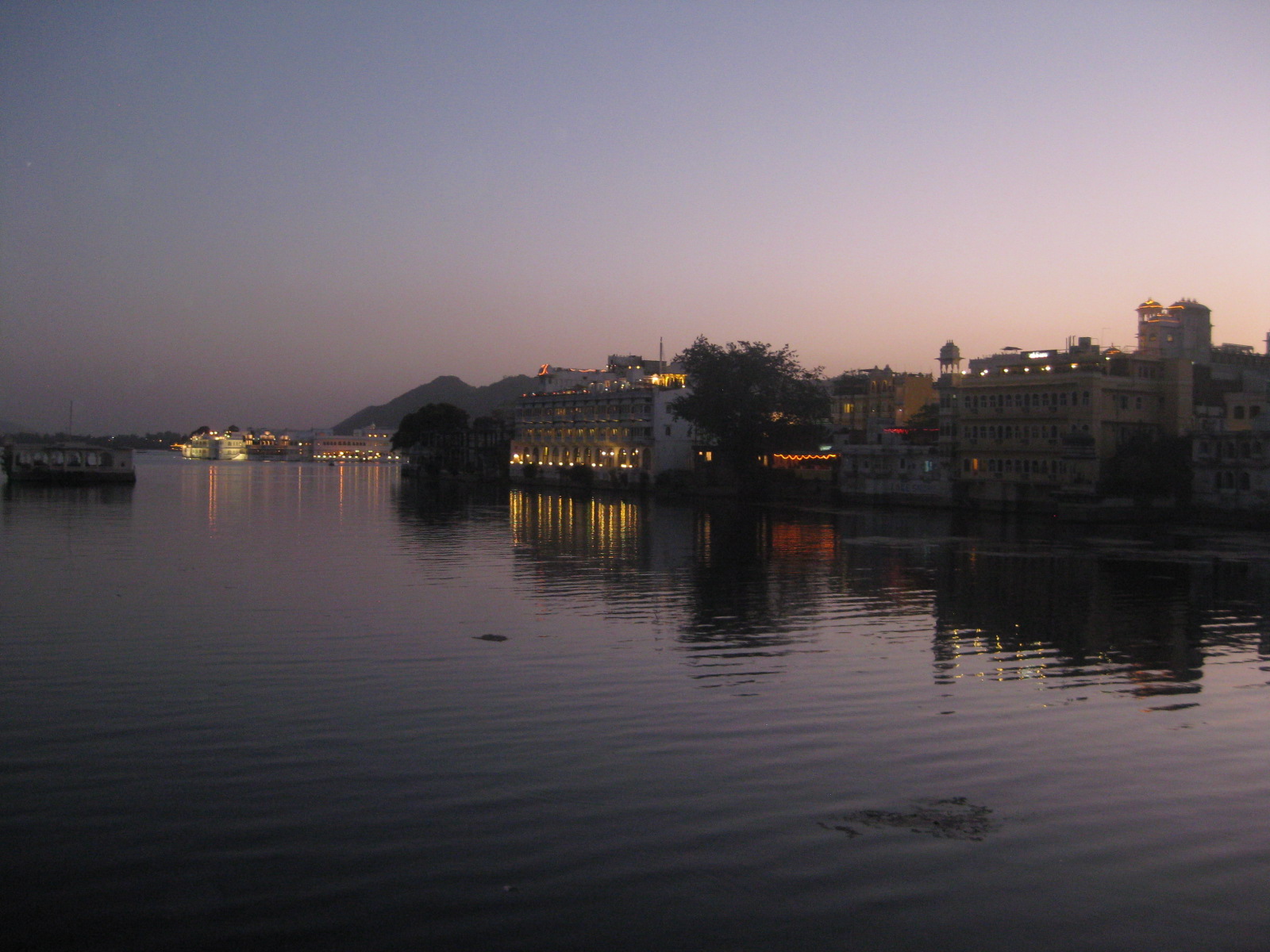
Udaipur is considered the most romantic city in India and along the water I can understand how the city got this description. The old city is situated around Lake Pichola, which rivals Varanasi in terms of aesthetic appeal because Lake Pichola is much cleaner than the Ganges and along the water is very well maintained. The area is famous from one of the older James Bond films called Octopussy in which the lake and palace were used and many restaurants show this film each night at 7:00 pm.

The old city is framed by the Aravalli hills and the outstanding sights are The City Palace and the Lake Palace, which are located in the middle of the lake. It seemed as though every restaurant that we went to in Udaipur was a rooftop and they all had incredible views of the old city and lake.


My time in Udaipur was especially memorable because we happened to be in the city during Holi. Holi is a Hindu festival of colours in which people in the streets will throw coloured dye on each other. It is meant to be a light, happy celebration. My Indian host family told me that there was no significant spiritual meaning to the festival, it is purely meant for enjoyment. Some people celebrate Holi for more than one day, however, the celebration with throwing dye is only one day. During Holi, businesses are closed during the celebration and social norms are relaxed. A common greeting during this time is “Happy Holi”, just like we would say “Merry Christmas” or “Happy New Year”.


One major problem with Holi is to do with the quality of the dye. There are natural and chemical dyes, although the natural dyes are more expensive. During Holy, people go for quantity rather than quality of dye. There are serious health affects associated with the chemical dyes, such as skin cancer and respiratory disorders. Also, foreign women can face the threat of inappropriately behaviour from some men who are drinking or are too caught up in the excitement of the festival. For these reasons, I did not participate in Holi but I was able to see some of the celebrations before and see the aftermath. I think that I would have had the best time participating in Holi if I was a young Indian boy.

After leaving a restaurant on the night before Holi we found ourselves among the Holi celebrations on the street. In the afternoon, huge piles of wood had been set up in the streets in teepees and these were lit on fire and burning all around. There were also fireworks being lit off around these fires. Families, groups of women, and groups of young men were on the streets enjoying the social celebration. Some people had brought huge speakers and were playing Bollywood as well as North American top 40 songs. The streets were not officially closed off but traffic was significantly affected.

On the day of Holi, the dye throwing ended around 3:00 pm and by about 5:00 we felt that we were safe to go check out the old city. The auto-rickshaw drive that we took to get to the old city was one of the strangest that I have taken in India. The streets of Udiapur were eerily quiet, which is very rare of any Indian city because of the large population of the country. There was evidence of the dye all over the streets, on scooters, auto-rickshaws and motorcycles, and on the cows roaming the streets. Some shop owners were starting to clean up the front of their shop in order to open for the afternoon and the last of the people who participated in the dye throwing festivities were slowing filing home to clean up. It seemed as though the young boys and men were the most covered in colour although I think that they were also the one throwing the most dye at others. Some older people were also covered in dye, although not as much as younger people.

During the days following Holi I was able to know who had participated in the festivities because some of the dye was still on their skin. I was told by a shop owner that many people will but oil on their skin before Holy. This way the dye will not stay on their skin and if they are caught by someone with dye then they can slip away. I saw many young boys with water guns during the days leading up to Holy. I learned that dye sinks into the skin better with the water than without.  

Monday, March 5, 2012

Jaisalmer


Jaisalmer is called the Golden City because the old city is constructed of the same golden honey sandstone. The fort is the main attraction of the city and it looks like a massive sandcastle in the middle of the desert. The inside of the fort is made up of narrow streets with shops, Jain temples, a maharaja's palace, and a museum. Jaisalmer Fort is a living fort, meaning that there are many people who live in it. On the first day when we were looking out over the city a man on the next rooftop invited us up onto his roof where there was an even better view of the city.


The streets that lead to the entrance of the fort are lined with shops that capitalize on the tourists coming through. You can buy leather good, handwoven table runners and wall hangings, pashminas, bedding, and various other ragasthani crafts. The shop owners are good sales people but hard bargainers – you have to be very persistent if you want to pay a fair price.


Among the shops on the streets leading to the fort we found one man's photography shop where he sold old prints of pictures taken in India. His family had been in the photography business for three generations on the same street in Jaisalmer. He showed us the old fashioned camera that his grandfather used to take pictures and said that all of the prints that he had for sale were pictures taken from this camera. For each picture there was a short story that the man could tell you about it. I chose a picture of two women dancers taken in 1911. These women were covered in jewelry- 10 bangles on each arm, about the same amount of anklets on each leg, and huge flower nose rings.

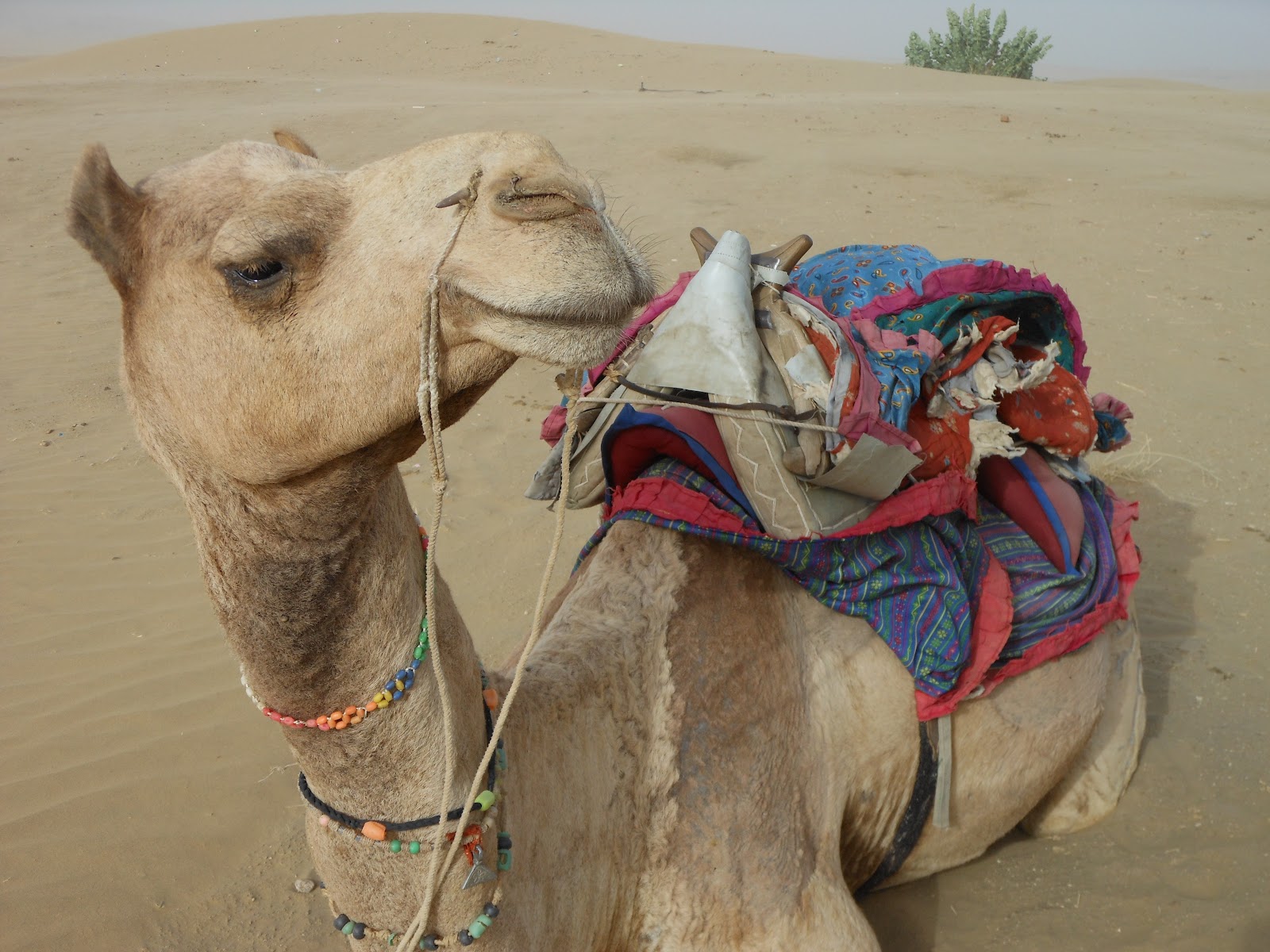
On the afternoon of the second day in Jaisalmer we took an hour bus ride out of the city and into the dessert where we spent the night. We were dropped off on the side of the road and were taken by camel to our tents. We were two to a camel and each camel was led by a little boy who helped us get on and off and kept checking that we were alright with their limited English vocabulary. We stopped part way to the tents to get off the camels and watch the sunrise on the sand dunes and the boys who guided our camels gave us the opportunity to ``race`` with them. I thought that I would give it a try and although a little scary it was really fun. My impression of camels from what I have seen of them here in India is that they are lazy animals that will do what you want them to, although not at a fast pace. I climbed on the front of the camel and the 10 year old boy who guided our camel went on the back, holding the reins like a horse. The little boy got the camel going so fast that I was literally bouncing in the air off the seat. When I started bouncing off to one side the little boy in the back had to hold my shoulders down so that I didn’t fall (although I think that if I was going down, he would not be strong enough to catch me).


During our camel ride to the tents and for the rest of the night the wind was very strong and was picking up sand with it. With a strong gust of wind, any body part that was not covered would be blasted by sand and it could actually be a bit painful (It was a little less graceful and glamourous than the girls in the latest Sex and the City movie). It reminded me of the feeling that you get when going skiing in the winter. We tried our best to cover our faces with scarves and sunglasses. I had the most trouble with getting sand in my eyes. I finally started to realize the practicality of a full burka in the dessert (here I was thinking that the women were oppressed and uncomfortable).

In the evening we were entertained by a ragisthani cultural music and dance show. It was shown on a circular raised stage outside and we were seated on cushions and pillows. After the performance we were had a ragisthani feast in the dinning hall and slept in our tents.  

Sunday, February 26, 2012

Varanasi


Varanasi is one of the holiest places in India. Hindu pilgrims come to the Ganges River (or River Ganga as it is called here)  to wash away their sins in the water or to cremate. Dying in Varanasi or being cremated here offers moksha (liberation from the life death cycle).

The first day in Varanasi was a huge change from south India and totally stimulating for the entire time. In the morning we took a auto-rickshaw to the Ganges and walked around, starting at the southern most ghat, the Assi Ghat and walking north along the Ganges River. Away from the water, there are many winding, narrow alleyways that are full of shops and restaurants. The monkeys use these narrow alleyways to their advantage and steal food from the offerings that people make to Ganesh (the Hindu elephant god). The great restaurants are easy to miss although they are worth being persistent and seeking out. For lunch we went to a place called the Brown Bread Bakery which is a restaurant associated with an NGO that supports a women's empowerment group and a school for children. Everything is organic and instead of chairs, there are cushions and low tables to hang out around.


In the evening, we went to a light festival called the Ganga Aarta on the water. We took a row boat out on the river as the sun was setting and the light ceremony was being set up. The first stop with our boat was the burning ghat in which people would bring their deceased relatives to be cremated on the shore of the Ganges. At this ghat you are not allowed to take photographs because of respect to the families. This ghat has a much quieter and somber mood compared to all the excitement at the other Ghats. Cremation happens at this ghat 24 hours a day and only the male members of the family are allowed to participate. Apparently the women cry too much and this means that the person does not have a good death. At this point I was really moved by how spiritual Hindu culture is in India and how different their perception to death is to that of western culture.


(piles of wood from the burning ghat)


After seeing the burning ghat we were taken back to the main ghat where the Ganga Aarta was being held. At this point I wished that I knew some more Hindi to better understand the chants. This ceremony featured fire and dance by 7 Hindu priests on shore. At the beginning of the Ganga Aarta, we each lit a lotus flower candle and set it adrift on the water. Before releasing the lotus flower candle you have to first think of someone dead then someone who is alive and make a wish for them. I thought that this was a good opportunity for me to be a part of the spirituality of Varanasi without sharing the same religion or beliefs.

When we returned to the hotel after a day at the ghats there was a wedding happening in the parking lot and the yard. I think that we must have shown up at the beginning of the wedding because the whole wedding party was having a dance party with an entire marching band in the parking lot before they actually entered the area where the wedding was set up. The bride was nowhere to be seen but the groom was the center of attention, dancing with the wedding party wearing a red and gold hat. I learned later that the bride was inside because there are particular steps that must be followed in an Indian wedding. Everyone seemed to be having a great time dancing together. I observed some Bollywood dances moves and also the typical corny dance moves from all weddings.

I was standing outside watching everything happen with a few of my friends and a man from the wedding approached me and asked me to join the wedding. He seemed to be the crazy brother and had to ask some of the family if I could join.  He took me over to meet the groom and some of the family. I felt really under dressed because I was not expecting to be going to a wedding but there was a warm welcome from the people in the wedding. I was told that I could come and join the actual wedding inside. I asked if the 3 other friends I was with could also come and they said that that was alright. We were about to go into the wedding when about 10 more of our friends showed up at the hotel and wanted to join the wedding as well. We thought that it would be too much of an imposition to get everyone into the wedding so we didn't end up going all the way in the wedding, however, we did dance with the band for a little while and entertained the wedding party.

On our second day in Varanasi we woke up at 5:00am to get to the Ganges for 6 and take a boat tour of the ghats in the morning. As the sun was setting the Ganges was full of activity. There were people meditating and praying along the shore, doing yoga, washing clothes, and bathing in the water. It was very beautiful and much more peaceful than the previous night.


We were dropped off on shore at the burning ghat and went to the Vishwanath Temple. It is the most popular Hindu temple in Varanasi which is also called the Golden Temple.
Later on we went to Saranath, where Buddha gave his first sermon. It was interesting to learn more about Buddism because Hinduism is the dominant religion in India. We also saw the Bendares Hindu University, which is the largest university in Asia. The campus was very calm and relaxing on a Friday afternoon and was a quiet break from the excitement of the ghats. The campus had wide tree-lined streets and plenty of park areas where students were studying, talking, and playing soccer and cricket.

Our last stop on the tour on the second day was at a place where they hand wove silk. I was surprised about how time consuming the whole process was. There was one man working at the silk loom and we were told that he worked 8 hour days and in such time he would make about 10 cm of the fabric. Each silk sari must take a very long time to make because each one has to be the same length. The benefit of making silk by hand as opposed to using a machine is that you can have more elaborate detail in the fabric.

After we were shown how the silk was made, we were taken to the shop next door. At this store they sold ties, scarves, bedding, and saris and they must have felt like they hit the jackpot having such a large group of tourists in their shop. The men who worked at this shop capitalized on the opportunity and pulled out so many items for us to look at. A very common saying here is "looking is free" because they know that if they show someone with money enough beautiful things a sale is very likely. There is a huge cushion on the floor and everyone sat around and told the sales people what they like and the sales people piled up one item after another until they found something to buy.


In the evening we took an auto-rickshaw back from dinner and what should have been a 20 minute ride turned into an hour drive that could only take 4 blocks from where we wanted to go. The reason for the unusually long drive was because there were so many weddings happening around the city. The streets were full of parades of people involved in the wedding. In the parades there were marching bands, big cars with huge music speakers, fireworks, and people carrying torches and lights over their heads. It was so exciting to see and I was almost glad to have a longer ride so that I could see the weddings. At points the traffic was literally stopped and our driver turned off the engine because the wedding events had taken up the street.

The last day in Varanasi was very relaxed. My friend Julie and I walked around the ghats for one last time, going back to some of our favourite places. Even though the water is very polluted I thought that I should take the opportunity to dip my feet into the Ganges.


On our way through one of alleyways to our favourite lunch place, the Brown Bread Bakery, we stopped in a shop that sold some cool hippy shirts that we liked. After picking out the shirts that we liked we were ready to start the bargaining process when the owner of the shop was insistent that we come and see his photo album in the next room. We did not want to stay in the shop too long but were too polite to refuse. He was so proud to show his pictures of Goldie Hawn (famous Hollywood actress and mother of Kate Hudson) in his store. According to the shop owner, every time Goldie Hawn comes to India (which is once every few years apparently) she comes to his store and buys pashminas. There was an old picture of the shop owner and Goldi Han from the 70s when the store owner had hair. There was also an entire photo album that the man had from one more recent visit that Goldie Hawn made to his store.


Monday, February 20, 2012

Hyderabad


We finished our exams in Mysore on Friday after a stressful five exams in four days. I was able to pick up on Indian mannerisms and styles of teaching through class with my Indian professors.  First of all, the Indian professors had a very traditional teaching style in that they would lecture facts and opinions to us that we were supposed to accept instead of critically analyse. Our science and technology teacher was famous for making broad statements in his classes. I remember that one of his slides said, "The economy is the core of society". I enjoyed my Women and Gender class because I was able to better understand the Indian family dynamic and Indian marriages. In terms of gender equality and women's rights, I think that there is progress being made in the form of a rising women's movement, however there is a long way to go. Hindi class was very challenging, however, I am glad that I took it. I am now able to write and read the alphabet, make simple sentences, and I know some vocabulary like numbers, colours, family members, and animals. In the train station from Mysore to Hyderabad I was able to make out some words in Hindi that were said over the loud speaker (mostly the numbers one to five- eik, tho, tiin, char, panch). I have made the observation that Indians have an equivalent of the Canadian expression, "eh", which is the expression, "isn't it?". This expression would be used by the professors when they were teaching. After they had made a point they would say "isn't it?" without really expecting a response and then go on with the lesson.

On Saturday we left Mysore and started travelling to the north. It was nice to stay in Mysore and have more time to explore the city, however, it is exciting to be travelling again. Leaving Mysore marks the halfway point in my semester abroad and a big change in going from the south to the north. South India has been very calm and the people have been very kind. From what I have heard, the north is a little rougher in that the cities are bigger, the begging is more aggressive, and you have to be smart about getting a fair deal for everything that you buy. Many of the cities in the north are more modern and have a definite western influence. The food is also supposed to be much heavier than in the south.

Hyderabad is the considered the old city and Secunderabad is the new part of the city. Together they are known as the twin cities. Secunderabad is strongly influenced by the rising middle class in India and a western influence.

In the morning of the first day in Hyderabad we went to a well known market downtown called the Ladd Bazar. It was situated in the old part of the city and it has the majority of the city's pearl trade. The government has certified several jewelry shops in the area as being authentic quality. Since it was Sunday, many of the stalls and shops were closed so we were not able to see the market in full affect.


Hyderabad is a large city and it has is more modern than any of the cities in the south that I have seen thus far. The streets are much cleaner and the sidewalks are not only present but they are also easy to walk on. In many other cities, you have to watch your step because the side of the road is very rocky and there will be pot holes that you have to look out for.

My friend and I went out looking for a trendy restaurant that we heard about called Le Cafe D'Art and decided that we would not be able to find it after a 30 minute walk around the same area. The address was only the street number and people in the area sent us in all directions looking for the place but we could not find it. This is a very typical occurrence in India and I have gotten used to the fact that things do not always work out the way you expect them to, especially with business. Instead of heading back to the hotel we decided to check out the mall that was in the area. Stepping into the mall was just like being in a mall in North America. It was Sunday night at about 8:00 pm but the mall was full and everything was open. Being in the mall made me very aware of the rising middle class in India.

After the mall we went to a very fancy restaurant called Fusion 9 for dinner. This restaurant had soft lighting, wood floors, and a nice bar in the middle of the seating area. It was the kind of place that I would not be able to afford at home because I am a student (gotta love that exchange rate) with water that is three times more expensive and salads that cost more than main courses at other Indian restaurants. We definitely felt as though we were being spoiled (especially because we spent the previous night on a loud, dirty overnight train in third class).  The bathrooms were also really nice at this restaurant- very clean with toilet paper and soap. I have been to some very scary bathrooms in India and I have gotten used to bringing my own toilet paper and hand sanitiser everywhere that I go. It was nice to have a bathroom with all of the comforts of home.

On the second day in Hyderabad we went to a fort in the morning, which was very impressive because of its size. The fort had stone steps that to the top of the fort where there was a really good view of the city.


We spent the afternoon at the horse races. I had never been to a horse race before and thought that this would be the best place to make a bet. I did the minimum bet of 100 rupees (2 dollars) on a horse called All the Fun mostly based on the name and unfortunately did not win. Everyone that I was with either lost 200 rupees or won just over 100 rupees at the end of the day. It was a very relaxing afternoon at the horse races. The stands were in the shade and there was a nice view of the city in the background of the race track. At the snack bar we could get samosas, pastries, pop, chai, and milky coffee and enjoy at we watched the races.
The race track was full of men with their stats books keeping track of the results of races and planning their next big bet. At one point in an intermission between races we were put on the jumbo tron at the track and when we put our hands up and waved they put us on the jumbo tron two more times. I don't think that it is a normal occurrence for a group of white tourists, mostly women to go to the race tracks and bet.

Many of the men we very willing to tell us about their betting strategy and would show us their card when their horse won. We met one man who had won 20 lack (thousand) rupees the previous day at the tracks and he could tell us everything about the horses in each race. My friend decided to put his money on the man's top choice for the last race and he ended up winning.


In the evening we went to a craft show along the water then to a restaurant with an amazing view called Waterfront. Just like the other dinner that I ate in Hyderabad this place was very fancy. The restaurant was right on the lake with a patio and a dinning room with huge glass windows overlooking the water. On a small island in the middle of the lake there is a huge Buddha statue that is lit up at night and there are water fountains all around the lake for aesthetic affect.

Hyderabad was a nice, comfortable city to spend time in and I think that it gave me a great insight into the life of the middle class in India. Tomorrow we have a 23 hour train ride to Varanasi.

Followers